

The Four Intelligences Competing for Control of the World
Holding the tension between social, personal, artificial, and natural intelligences

Trillions of dollars of economic value is being wasted every year due to dysfunction inside organizations.
The primary dysfunction comes from the tension between the Social (what the group needs) and the Personal (what one person wants).
But another dysfunction is also present and about to explode: The tension between the Artificial (bureaucracy, technology, and AI) and the Natural (human intelligence and physical needs).
Each of these four elements is important, and when they work together with each other the results are spectacular. But when they’re out of harmony with each other, pain, sickness, and waste are the result.
We are overwhelmed by information. Even if you try to avoid the news and social media, eventually we have to go through our email inboxes. Each one of these channels can be a stream of disturbing information trying to incite us to take action for some cause. It’s easy to experience these streams in a toxic and distressing way that disturbs our mind. But each message can also be seen as a cry for help from someone who is in pain. Depending on where you sit in the world, you hear different cries of pain. We are all moved by the many disturbing messages we receive:
Look how harmful this behavior is to our larger group! (Social)
Look how unfairly this person was treated! (Personal)
Look at the opportunity that technology presents! (Artificial)
Look how humanity and nature are at risk! (Natural)
If we are truly open to being in dialog with others, we can always come to appreciate their points of view. The root of our global disharmony is our failure to engage deeply in dialog.
As a tool to promote dialog I have created and use a diagram which I call the Living Code mandala.
The Living Code Mandala
Four intelligences create tension in our world: Social, Personal, Artificial, and Natural. Those four intelligences operate inside of and through us. What we call “our” intelligence is a small and fragile biological incubator for a tiny subset of the world’s intelligence. Inside this bag of flesh, our nervous systems are growing an understanding of the four intelligences that surround us and make us up. Intelligence is coming to recognize itself.
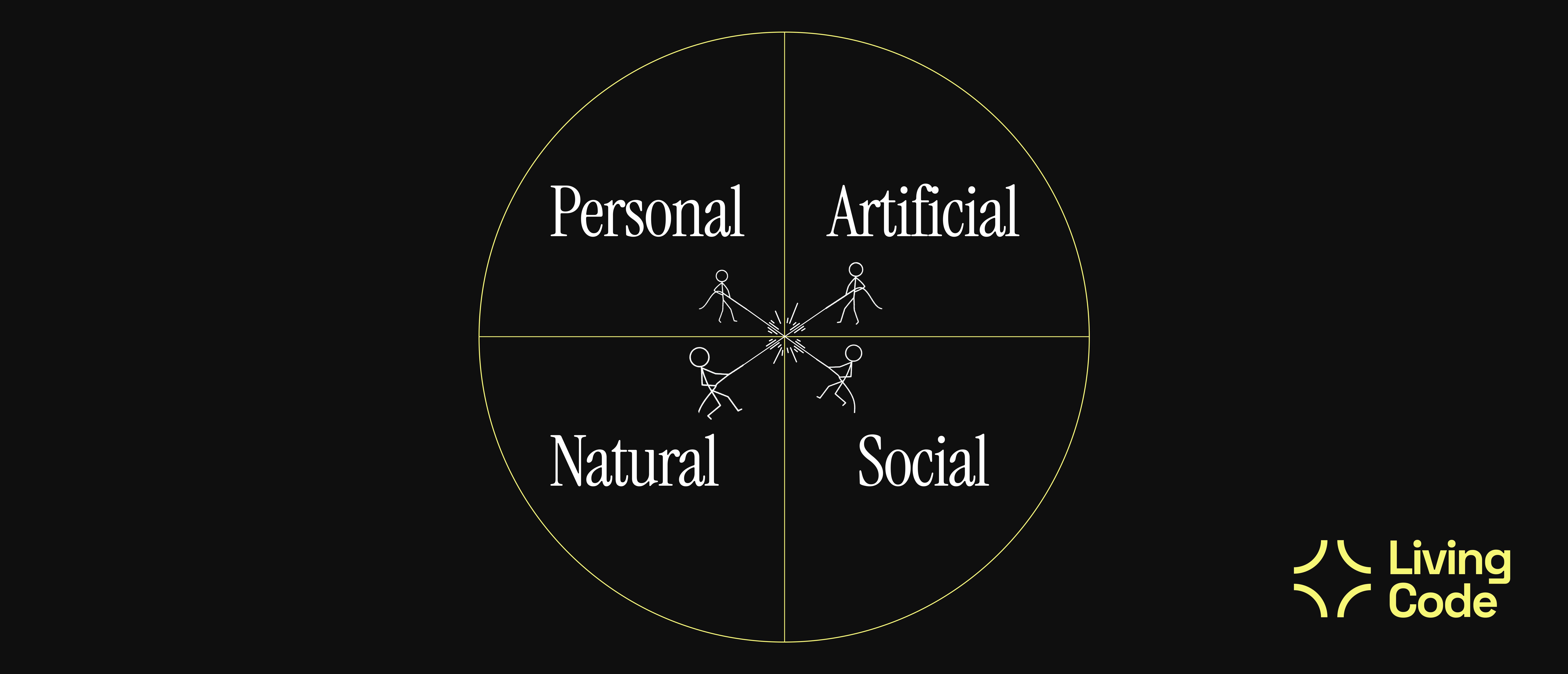
These four intelligences are simultaneously acting on the world and observing their own actions. To understand or take effective action in the world, we need to develop these four intelligences in ourself.
A mandala is a traditional way of helping hold space for many things in tension. Equivalent symbols are present in most societies under different names. Indigenous communities refer to “medicine wheels”. The Celtic Cross is one of the oldest symbols in European culture, and in East Asia, the concept of yin and yang and the I Ching represents complementary forces in dynamic balance. Each tradition recognized that reality emerges from the interplay of fundamental tensions.
The Living Code mandala is a mirror. You can see your own reflection, and you can hold a reflection of the whole world.
Scopes of Crisis
If we just want to consider the tensions inside of ourself, we can use the mandala: “Where is there tension inside me between the needs of others around me and my personal needs? How do the artificialities within and around me impact my natural potential?”
If we want to consider dysfunction inside of an organization, we can use the mandala: “How is the collective enterprise, what does it need? Where, how, and why are individuals struggling? Where would we benefit from automation? What natural qualities do we need to reinforce?”
And if we want to turn our attention to the broader Polycrisis, where the world is burning with endless conflict, turmoil, and risk, we can use the mandala: “What issues are afflicting our social health? What issues are afflicting individuals? What is the impact of our technology? How can we regenerate the natural world?”
A Simple Tool
This is not a complicated idea. Others have undoubtedly created diagrams like this in the past. But it’s an idea simple enough to fit in the head as a thinking tool, and versatile enough to help make sense of a broad range of challenges. As Claude Lévi-Strauss said:
“The question to ask about the pencil is not ‘What does it do?’ but ‘What does it allow us to think?’ The same is true of any tool of thought.”
I’ve been further encouraged in this insight in that Dr. Elif Kuş Saillard recently came to the same conclusion, which she frames as four bodies. She explains how she reached this conclusion through deep semantic analysis by studying communication inside of corporations and across society. Her explanation reinforces and extends my own understanding.
SPAN
AI is growing quickly. If something is growing, it is consuming space. What space is AI consuming? The shared space of our existing intelligences, also known as the epistemic commons or the noosphere.
The epistemic commons is already in danger from political polarization and misinformation. The last ten years have shown that governments and political strategists are able to control the epistemic commons well enough to orchestrate elections. Artificial Intelligence, as an emerging entrant to our epistemic space, should be viewed with suspicion.
The epistemic commons is invisible, and none of us can hold all of it in our minds. But if we don’t develop a vast perspective we won’t be able to make sense of the full scope of what’s happening to us. If we can’t understand what’s happening to our collective intelligence, we won’t know where to apply our efforts to help.
Our intelligence is the span of our awareness, what Michael Levin calls our cognitive light cone. Conveniently, we can remember these four categories of intelligence using the acronym SPAN:
SPAN - Social, Personal, Artificial, and Natural Intelligences
Social Intelligence: Organizations and other social groups have emergent social dynamics that are not reducible to the individuals. When social dynamics dominate, these groups function as superorganisms, a single organism composed of many smaller organisms. Strong and coherent social dynamics create an extremely efficient entity, for better or worse. To navigate the coming decades we will need to bring our A-game to the struggle against existential threats. By cultivating practices that support social coherence, we can raise a group’s intelligence far beyond the sum of individual IQs.
Personal Intelligence: All of the countless aspects of present and potential capability as people. Understanding ourself allows us to continually adapt to become a healthier individual physically, mentally, and spiritually.
Artificial Intelligence: The new kid in town. Proper AI has only reached the public in the last few years. It has enormous potential and is already impacting our lives in many ways. The potential side-effects of the introduction of this technology in human society are numerous but the bottom line is that it is here and we must understand it so that we can live in harmony with it in the future.
“We have agency. A choice to see AI and technology as something to fear as a diminisher of humanity or an enabler that can help us do more and be more.”
Natural Intelligence: Will our human qualities be accentuated by relying on AI? Or will we become even more addicted and deceived? In a world where cognitive intelligence is being outsourced to AI, we may find ourselves needing to train our brains in order to avoid atrophy. The same way in which we attend a physical gym for our muscles in a sedentary world, we must attend an equivalent mind-gym of sorts to stay healthy mentally. The ancient Greek word askēsis means to exercise, work out, or train. In the first and second century CE this word became adopted by Stoics and early Christian communities to refer to spiritual training, from which we get the term asceticism. We can already see society adopting practices that were previously the domain of monks such as using yoga and mindfulness to train our attention, intention, and adaptability.
Building our Four Intelligences
Our first responsibility and highest area of leverage is looking after ourselves. Here’s a simple practice to start using the Living Code mandala. This practice is inspired by and adapted from the Personal Mandala practice by Dr. Mette Miriam Boell of the Center for Systems Awareness.
Have a journal with you.
On a clean sheet of paper draw the mandala and label the four quadrants
For each of the four quadrants, follow this process:
Contemplate that quadrant: What aspects of your life and experience does this touch?
Sit quietly, maybe closing your eyes, and see what comes to mind
Set a timer for 3 minutes and write a list of ideas or thoughts that come to your mind about that quadrant. Write continually without stopping
Identify the two most positive and the two most negative items on that list. Mark the positive ones with a + and the negative ones with a -
Optionally, sense what color feels associated with those four items, and mark them with that color.
Copy those most relevant positive or negative experiences onto that quadrant in the Living Code mandala
Repeat this process for the other 3 quadrants
When you’ve finished, you’ll have a single picture that captures some of the most salient aspects of your world.
Look at all of these dimensions laid out before you. What conclusions emerge as you contemplate this picture?
Is there any pattern to the colors across the different quadrants?
Don’t rush to action, just sense what it feels like to be suspended in the tensions between these elements.
Let me know how this experience goes for you! What tensions do you feel between these four intelligences operating in your world?